
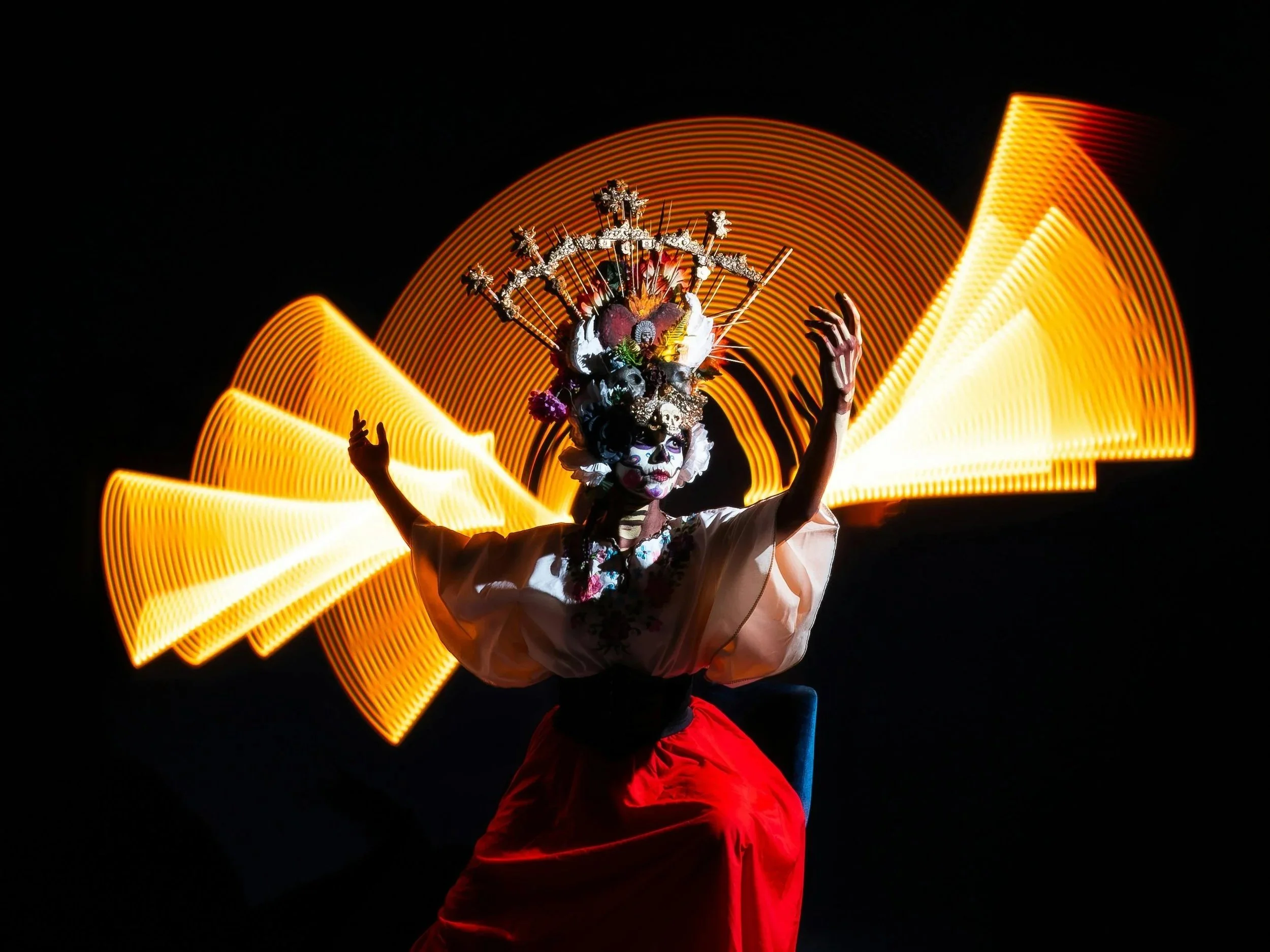
Dia de los Muertos

Thursday, November 6, 2025 - 7:00 PM
Friday, November 7, 2025 - 7:00 PM (please join us for a reception following this performance)


Mexican Cultural Institute
75 min
Join us for Dia de los Muertos,"The Day of the Dead," a day of reverence and celebration, and an important holiday in Mexico. Enjoy the beauty of the Mexican Cultural Institute, all decorated for the holiday. All of this, plus a program of well-known Mexican composers.
Program
JOSÉ PABLO MONCAYO (arr. Manual Enriquez) Huapango
SILVESTRE REVUELTAS Homenaje a Federico García Lorca
MANUEL M. PONCE Intermezzo & Concert Etude No. 3, “Hacia la cima”
Performed on piano by Artistic Director Alejandro Hernandez-Valdez
SILVESTRE REVUELTAS Suite from Redes (concert version)
ARTURO MÁRQUEZ Danzón No. 2
About the Artists
-
Esteemed conductor and pianist Dr. Alejandro Hernandez-Valdez is Artistic Director of Musica Viva NY and Director of Music at the historic Unitarian Church of All Souls in Manhattan. He is also Artistic Director and co-founder of the New Orchestra of Washington, and Artistic Director of the Victoria Bach Festival. He has earned accolades from The Washington Post as a conductor “with the incisive clarity of someone born to the idiom,” as well as praise from The New York Times for leading “a stirring performance” of Brahms’ Ein Deutsches Requiem. At a concert commemorating the 100th Anniversary of the WWI Armistice (featuring the world premiere of Joseph Turrin’s cantata, And Crimson Roses Once Again Be Fair) Oberon’s Grove wrote: “Maestro Alejandro Hernandez-Valdez drew rich, warm sounds from the musicians” in “a beautiful and deeply moving program.” He is featured in El mundo en las manos/Creadores mexicanos en el extranjero (The World in Their Hands/Creative Mexicans Abroad), a book by the Mexican Ministry of Foreign Affairs honoring Mexican nationals who are leading figures in diverse artistic fields. He is the recipient of a 2016 Shenandoah Conservatory Alumni of Excellence Award for his exemplary contribution to his profession, national level of prominence, and exceptional integrity. He resides in New York City.
In 2016, during its 40th anniversary season, Hernandez-Valdez was named the third Artistic Director of the Victoria Bach Festival in Texas. As Mike Greenberg wrote in Classical Voice America: “A big question mark hung over the venerable Victoria Bach Festival two years ago when the brilliant Craig Hella Johnson, its artistic director since 1992, decided to give up the post…Johnson’s successor has replaced the question mark with an exclamation point — perhaps more appropriately, given his Spanish name and Mexican provenance, two exclamation points: ¡Alejandro Hernandez-Valdez!” “The results,” Greenberg continued, “were astonishing.”
Founded in 1977, Musica Viva NY was recently praised by The New York Times as “an excellent chorus.” The ensemble has a longstanding tradition of top-caliber performances, innovative programming, and a strong dedication to the commissioning of new music. Its alumni include Renée Fleming, Samuel Ramey, and Michael Maliakel. Since taking the helm at Musica Viva NY in 2015, Hernandez-Valdez has presented an exceptionally broad and innovative repertoire in each of the choir’s seasons, engaging and inspiring audiences with remarkable interpretations of familiar and new works, and exploring the acoustical capabilities of the historic sanctuary of All Souls Church and other venues on Manhattan’s Upper East Side.
As the Artistic Director and co-founder of the New Orchestra of Washington (NOW), a chamber orchestra that “has constituted itself in the forefront of this smaller-is-better movement” (The Washington Post), Hernandez-Valdez has been reimagining for the past ten years what have been the limited definitions of “classical music.” NOW’s innovative programming and creative approach to music performance continues to reshape and enrich the cultural landscape of the National Capital Region.
A passionate advocate of new music, Hernandez-Valdez has commissioned and premiered works by Joan Tower, Arturo Márquez, Joseph Turrin, Gilda Lyons, Seymour Bernstein, Viet Cuong, Juan Pablo Contreras, Elena Ruehr, Ramzi Aburedwan, Jorge Vidales, Mokale Koapeng, Trent Johnson, Javier Farias, Andrés Levell, Zachary Wadsworth, Martin Spruijt, Joel Friedman, and other notable composers.
Hernandez-Valdez’s guest conducting engagements include appearances at The Kennedy Center in Washington, D.C., Lincoln Center in New York City, and the historic Degollado Theatre in Guadalajara, Mexico, where he has directed the Jalisco Philharmonic. As a pianist, Hernandez-Valdez performed for the 2013 Britten100 festival in New York City, organized by the Britten-Pears Foundation to honor the 100th anniversary of the titular composer’s birth. As a composer and conductor, he led the premiere of his own composition, The Imaginary City, a cantata inspired by the life of Ramzi Aburedwan, a violist who has opened schools throughout Palestine to teach music to children in refugee camps. He also arranged and premiered the chamber orchestra version of A Song of Nature by Seymour Bernstein. Mr. Bernstein, the subject of Ethan Hawke’s 2014 documentary film, Seymour: An Introduction, is one of Hernandez-Valdez’s most influential teachers and mentors.
-
Sergey Prokofyev, Concertmaster
Milena Aradski, 2nd Violin
Erika Gray, Viola
Valeriya Sholokhova, cello
Nicholas Greer-Young, bass -
Conor Nelson, Flute
Stephen Key, Oboe
Jeremy Eig, Clarinet
Rajeesh Soodeen, Clarinet
Ryan Romine, Bassoon -
Justin Drew, Horn
Ben Ruiz, Horn
Jose Oviedo, Trumpet
Les Linn, Trumpet
James Martin, Trombone
Zach Bridges, Tuba -
Chris Dechiara, Percussion & Timpani
Sean Van Winkle, Percussion
Dana Dominguez, Percussion
Eric Sabatino, Harp
Wei-Han Wu, Piano
About the Pieces
-
A sparkling emblem of Mexican orchestral music, Huapango (1941) is José Pablo Moncayo’s vibrant tribute to the folk traditions of Veracruz. Drawing on three popular sones huastecos—El Siquisirí, El Balajú, and El Gavilancito—Moncayo transforms their rhythmic vitality and improvisatory flair into a dazzling symphonic showpiece. Its infectious syncopations, call-and-response melodies, and exuberant dance rhythms capture the spirit of the Mexican people and their love of music as a communal expression. Huapango has become an unofficial national anthem of Mexico and remains a brilliant celebration of the nation’s musical identity. This was the first piece of music that moved me beyond comprehension when I was a young child. I still remember the excitement and sense of total immersion from the first to the last note.
-
Composed in 1936 as a tribute to the Spanish poet Federico García Lorca—executed at the outbreak of the Spanish Civil War—Revueltas’s Homenaje a García Lorca is both elegy and outcry. Scored for a chamber ensemble, the work unfolds in three concise movements that blend Mexican and Spanish folk idioms with Revueltas’s unmistakable modernist voice. The opening Baile bursts with sardonic energy, while the central Duelo mourns with stark simplicity and haunting lyricism. The final Son combines rhythmic drive and biting dissonance, ending the work in a spirit of defiant vitality. Revueltas’s tribute is less a lament than a powerful affirmation of the enduring strength of art in the face of oppression.
-
Composed in 1935 as a film score for a revolutionary drama about the struggles of Mexican fishermen, Redes (“Nets”) stands as one of Silvestre Revueltas’s most stirring and socially conscious works. The music vividly evokes the strength and solidarity of the working class through bold orchestral colors, incisive rhythms, and deep emotional intensity. In this concert suite, the score’s cinematic immediacy is fully revealed—rising from lyrical melancholy to surging power. The work’s raw energy and sense of collective struggle reflect Revueltas’s empathy for ordinary people and his belief in art as a force for social justice.
-
Few works have captured the imagination of audiences as completely as Arturo Márquez’s Danzón No. 2 (1994). Inspired by the Cuban-Mexican dance form popular in Veracruz and Mexico City, Márquez transforms the danzón into a lush symphonic conversation between elegance and passion. The piece’s seductive opening clarinet solo gives way to a kaleidoscope of rhythmic interplay and orchestral brilliance. With its sensual sway, dramatic crescendos, and irresistible energy, Danzón No. 2 celebrates Latin American identity in full color. Made internationally famous by Gustavo Dudamel and the Simón Bolívar Symphony Orchestra, it has become one of the defining works of contemporary Mexican music.
Support NOW
The New Orchestra of Washington is currently accepting donations toward the Deutsch Family Matching Grant. Any gift made before December 31, 2025 will be matched dollar for dollar by the Deutsch Family. If you would like to join in supporting NOW, learn more and donate to the match HERE.