
Songs for the Departed:
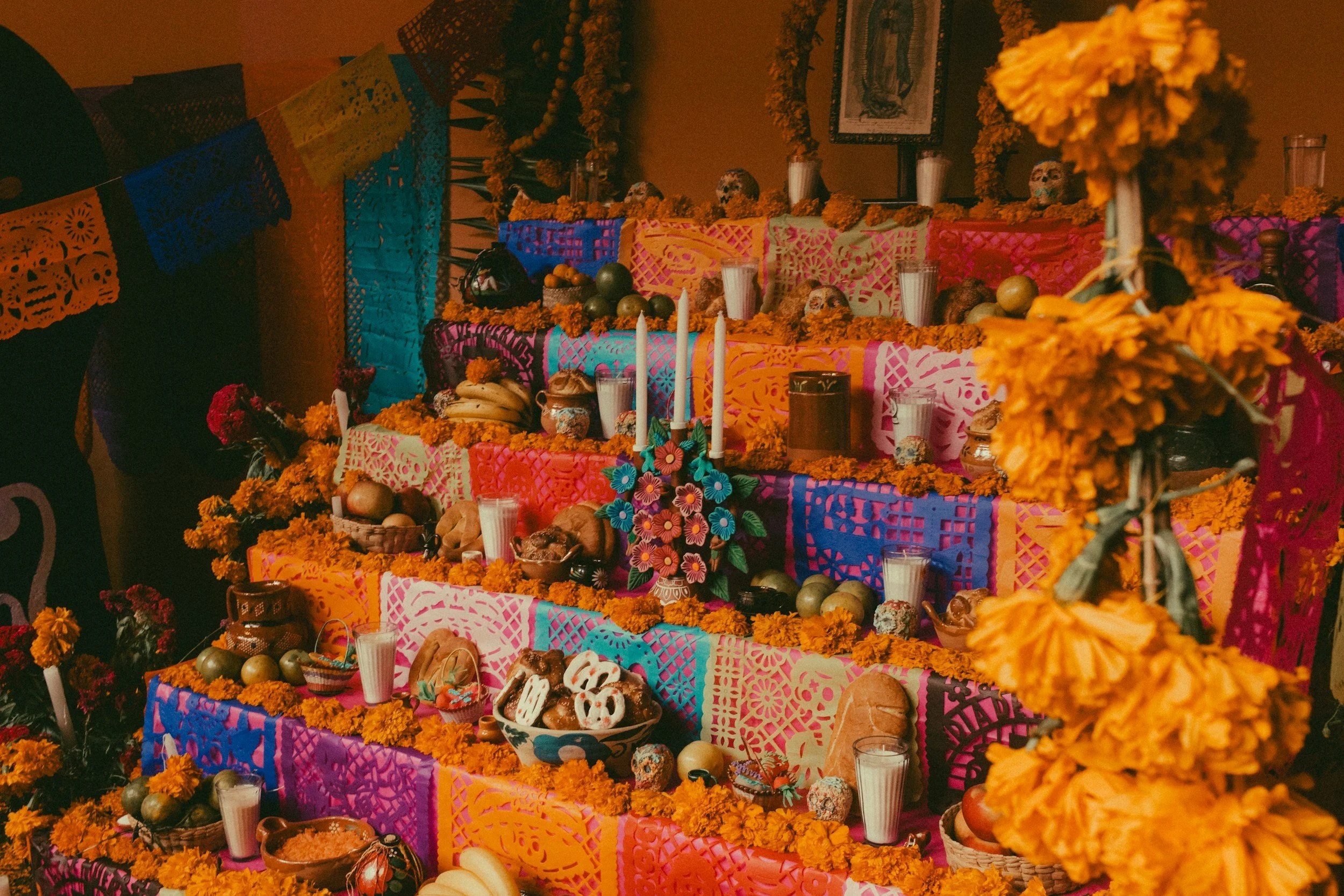
A Celebration of Día de los Muertos

Sunday, November 1, 2026 - 7:00 PM
Ticketed Pre-Concert Reception beginning at 5:30 PM


Atlas Performing Arts Center
105 min (including 15 min intermission)
Join us for a vibrant celebration of Día de los Muertos, a cherished tradition of remembrance and celebration that has long been part of the New Orchestra of Washington’s history. Under the leadership of Artistic Director, Alejandro Hernandez-Valdez, NOW presents an exciting program of works by composers including Aaron Copland, José Pablo Moncayo, Ralph Vaughan Williams, Silvestre Revueltas, Maurice Ravel, and Juan Pablo Contreras. Joining us on stage is local rising star Emma-Grace Kim.
Make the evening even more special by purchasing a special ticket to join us for a pre-concert reception featuring delicious light fare, drinks, live music, and a silent auction benefiting NOW’s educational and outreach programs. Come share in an evening of music, remembrance, community, and celebration with us!
Program
AARON COPLAND - Quiet City
JOSÉ PABLO MONCAYO - Homenaje a Cervantes
RALPH VAUGHAN WILLIAMS - The Lark Ascending featuring Emma Grace Kim, violin
SILVESTRE REVUELTAS - Sensemayá
MAURICE RAVEL - Pavane pour une infante défunte
JUAN PABLO CONTRERAS - Mariachitlán
About the Artists
-
Esteemed conductor and pianist Dr. Alejandro Hernandez-Valdez is Artistic Director of Musica Viva NY and Director of Music at the historic Unitarian Church of All Souls in Manhattan. He is also Artistic Director and co-founder of the New Orchestra of Washington, and Artistic Director of the Victoria Bach Festival. He has earned accolades from The Washington Post as a conductor “with the incisive clarity of someone born to the idiom,” as well as praise from The New York Times for leading “a stirring performance” of Brahms’ Ein Deutsches Requiem. At a concert commemorating the 100th Anniversary of the WWI Armistice (featuring the world premiere of Joseph Turrin’s cantata, And Crimson Roses Once Again Be Fair) Oberon’s Grove wrote: “Maestro Alejandro Hernandez-Valdez drew rich, warm sounds from the musicians” in “a beautiful and deeply moving program.” He is featured in El mundo en las manos/Creadores mexicanos en el extranjero (The World in Their Hands/Creative Mexicans Abroad), a book by the Mexican Ministry of Foreign Affairs honoring Mexican nationals who are leading figures in diverse artistic fields. He is the recipient of a 2016 Shenandoah Conservatory Alumni of Excellence Award for his exemplary contribution to his profession, national level of prominence, and exceptional integrity. He resides in New York City.
In 2016, during its 40th anniversary season, Hernandez-Valdez was named the third Artistic Director of the Victoria Bach Festival in Texas. As Mike Greenberg wrote in Classical Voice America: “A big question mark hung over the venerable Victoria Bach Festival two years ago when the brilliant Craig Hella Johnson, its artistic director since 1992, decided to give up the post…Johnson’s successor has replaced the question mark with an exclamation point — perhaps more appropriately, given his Spanish name and Mexican provenance, two exclamation points: ¡Alejandro Hernandez-Valdez!” “The results,” Greenberg continued, “were astonishing.”
Founded in 1977, Musica Viva NY was recently praised by The New York Times as “an excellent chorus.” The ensemble has a longstanding tradition of top-caliber performances, innovative programming, and a strong dedication to the commissioning of new music. Its alumni include Renée Fleming, Samuel Ramey, and Michael Maliakel. Since taking the helm at Musica Viva NY in 2015, Hernandez-Valdez has presented an exceptionally broad and innovative repertoire in each of the choir’s seasons, engaging and inspiring audiences with remarkable interpretations of familiar and new works, and exploring the acoustical capabilities of the historic sanctuary of All Souls Church and other venues on Manhattan’s Upper East Side.
As the Artistic Director and co-founder of the New Orchestra of Washington (NOW), a chamber orchestra that “has constituted itself in the forefront of this smaller-is-better movement” (The Washington Post), Hernandez-Valdez has been reimagining for the past ten years what have been the limited definitions of “classical music.” NOW’s innovative programming and creative approach to music performance continues to reshape and enrich the cultural landscape of the National Capital Region.
A passionate advocate of new music, Hernandez-Valdez has commissioned and premiered works by Joan Tower, Arturo Márquez, Joseph Turrin, Gilda Lyons, Seymour Bernstein, Viet Cuong, Juan Pablo Contreras, Elena Ruehr, Ramzi Aburedwan, Jorge Vidales, Mokale Koapeng, Trent Johnson, Javier Farias, Andrés Levell, Zachary Wadsworth, Martin Spruijt, Joel Friedman, and other notable composers.
Hernandez-Valdez’s guest conducting engagements include appearances at The Kennedy Center in Washington, D.C., Lincoln Center in New York City, and the historic Degollado Theatre in Guadalajara, Mexico, where he has directed the Jalisco Philharmonic. As a pianist, Hernandez-Valdez performed for the 2013 Britten100 festival in New York City, organized by the Britten-Pears Foundation to honor the 100th anniversary of the titular composer’s birth. As a composer and conductor, he led the premiere of his own composition, The Imaginary City, a cantata inspired by the life of Ramzi Aburedwan, a violist who has opened schools throughout Palestine to teach music to children in refugee camps. He also arranged and premiered the chamber orchestra version of A Song of Nature by Seymour Bernstein. Mr. Bernstein, the subject of Ethan Hawke’s 2014 documentary film, Seymour: An Introduction, is one of Hernandez-Valdez’s most influential teachers and mentors.
-
Emma-Grace Kim is a 17-year-old violinist from Herndon, Virginia and currently studies with Jing Qiao of the National Symphony Orchestra. Since she began her violin studies at age seven, she has performed as a featured soloist at the Kennedy Center, Carnegie Hall, WETA Classical’s Salon Series, the House of Sweden, and the Embassy of the Republic of Korea. Emma participated in NPR From the Top’s Learning and Media Lab Fellowship, and has served as concertmaster of the American Youth Philharmonic Orchestras and Boston University’s Tanglewood Institute Young Artist Orchestra. In 2025, she had the honor of participating in the National Youth Orchestra of the United States where she had the opportunity to tour Asia with Maestro Gianandrea Noseda and Violinist Ray Chen.
Emma-Grace is committed to serving her community through ITZArt4you, a non-profit organization she co-founded in 2021, that provides weekly music lessons to children in underserved communities.
About the Pieces
-
Harold Clurman, Copland's closest friend, was a founder of the Group Theatre. He had long hoped for a collaboration between Copland and the Group; the opportunity came with Irwin Shaw's play, Quiet City. Clurman convinced Copland to compose incidental music to a script about a distressed trumpet player, who played to express the emotions of different people in various parts of the city. After a few tryouts, the play was dropped, but as Clurman pointed out, "Aaron just scooped up that music and arranged a suite for trumpet, English horn, and string orchestra. The play was long forgotten but the music lives on."
-Vivian Perlis, 1998 -
Moncayo studied harmony with Huízar, the piano with Hernández Moncada and composition with Chávez at the Mexico City Conservatory. By Chavez in a concert at new York City’s Museum of Modern Art, and again like Galindo, Moncayo went on to study with Aaron Copland at the Berkshire Music Center (1942). He began his musical career in 1931 as a percussionist in the Mexican Symphony Orchestra, which he conducted from 1949 to 1954. In 1934, along with Galindo, Contreras and Ayalas, he formed the Group of Four whose aim was to rekindle the nationalist spirit in Mexican music. Some of Moncayo’s works – in particular his famous Huapango – incorporate popular melodies, in this case the folkdances el siquisirií, el balajú and el gavilán. Regrettably, the popularity of this piece has obscured the rest of Moncayo’s small, original output: for example Amatzinac and Bosques, which display Impressionist traits and a predominantly modal harmonic idiom, and the Muros verdes for piano, whose sequence of motifs describe a spiral form. His opera La mulata de Córdoba – based on the work of the same name by Xavier Villarrutía – tells the story of an enchantress condemned to death during the Inquisition who disappears, on the point of being executed, in a boat cloud of fire. Moncayo’s modernist style admirably combines with the poetry of the text to create one of the finest 20th-century Mexican operas. Such was his significance that his death in 1958 is considered to mark the end of the nationalist school in Mexico.
--Ricardo Miranda Pérez -
-
-
-
Mariachitlán (Mariachiland) is an orchestral homage to my birthplace, the Mexican state of Jalisco, where mariachi music originated. The work recounts my experience visiting the Plaza de los Mariachis in Guadalajara, the capital of Jalisco, a place where mariachis play their songs in every corner and interrupt each other to win over the crowd.
In Mariachitlán, traditional rhythms such as the canción ranchera (ranchera song) in 2/4 time (choon-tah choon-tah), the vals romántico (romantic waltz) in 3/4 time (choon-tah-tah), and the son jalisciense (Jalisco song) that alternates between 6/8 and 3/4 time, accompany original melodies inspired by the beautiful landscapes of Jalisco. Mariachi instruments such as the trumpet, harp, and violin are featured as soloists in this work. Furthermore, the strings emulate the strumming patterns of vihuelas, while the contrabasses growl like guitarrones.
Near the end of the piece, a policeman blows his whistle in an attempt to stop the party. However, the crowd chants Mariachitlán, gradually increasing in intensity, and is rewarded with more vibrant music that ends the work with great brilliance.
The original version of Mariachitlán (2016), scored for symphony orchestra, won the 2016 Jalisco Orchestral Composition Contest and was nominated for a 2019 Latin GRAMMY® Award for Best Arrangement.
—Juan Pablo Contreras (May 2021)
This arrangement of Mariachitlán was commissioned by Los Angeles Chamber Orchestra.
Premiered on June 26, 2021, at the Walt Disney Concert Hall in Los Angeles, United States,
by Los Angeles Chamber Orchestra, conducted by Jaime Martín
Recorded by the Orquesta Latino Mexicana,
conducted by Juan Pablo Contreras, for Universal Music Mexico