New Orchestra of Washington presents
Beethoven Five
Saturday, April 1 | 5:00 PM
The John F. Kennedy Center for the Performing Arts
Terrace Theater
2700 F St., NW, Washington, DC 20566
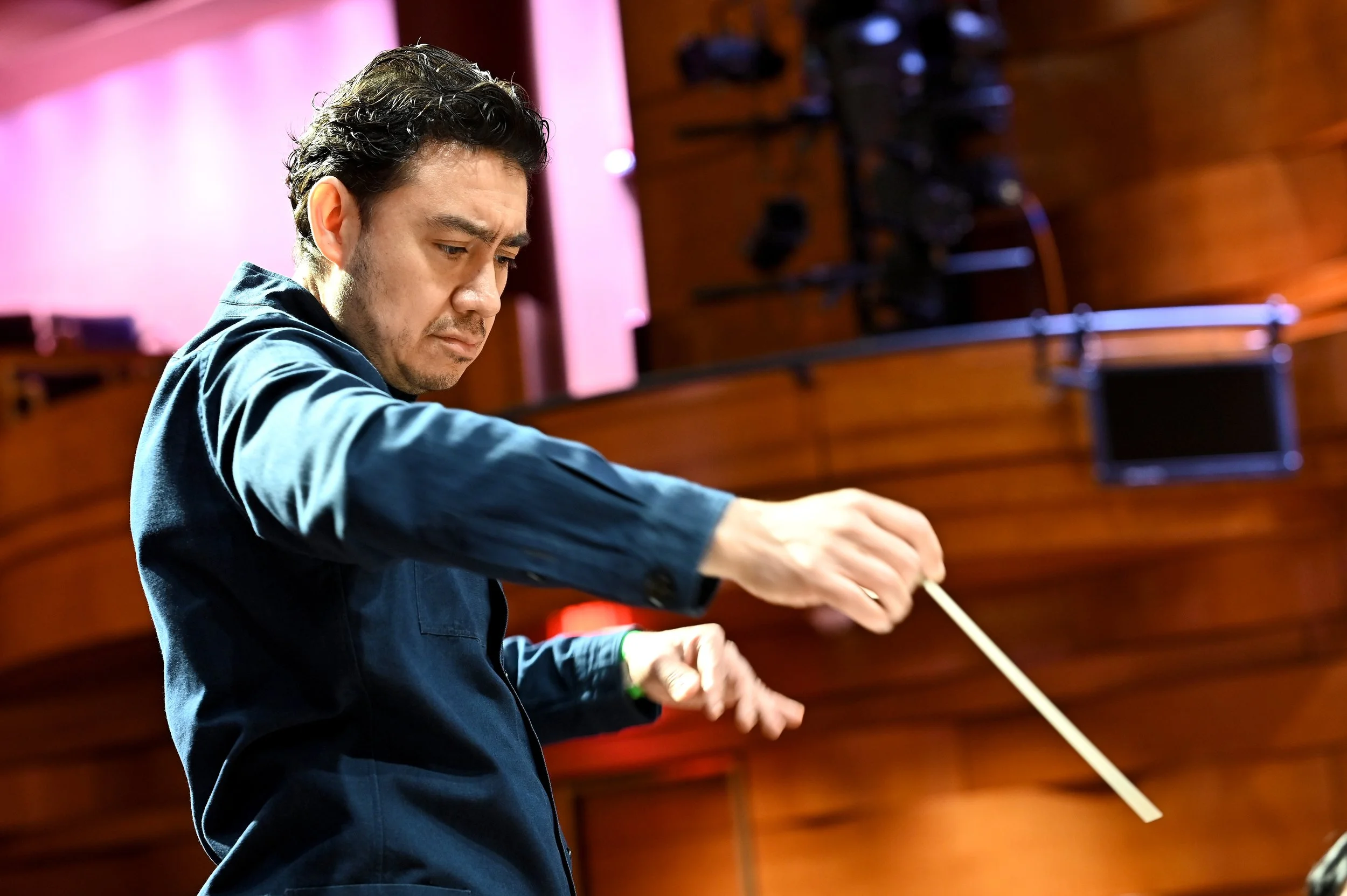
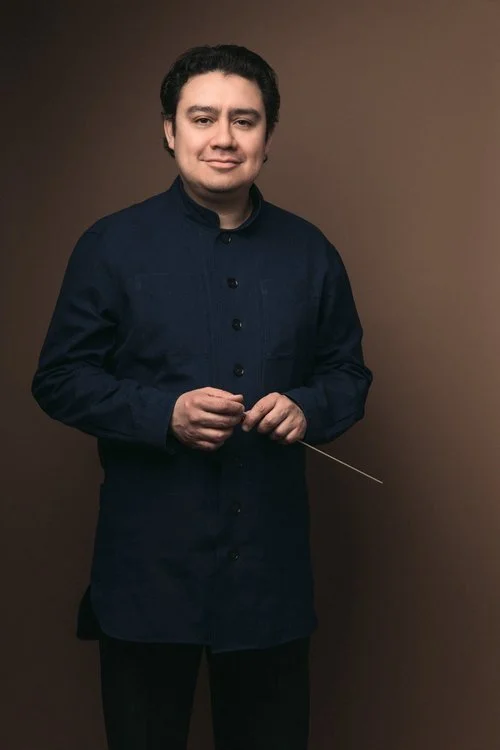
Dr. Alejandro Hernandez-Valdez, conductor
Miray Ito, violin
This concert is made possible thanks to the generous support of the Ryuji Ueno Foundation.
This performance is an external rental presented in coordination with the Kennedy Center Campus Rentals Office and is not produced by the Kennedy Center.
Who Wrote it Better?
-
In 1808 two works of uncanny similarities were written: Étienne Nicolas Méhul’s Symphony No. 1 in G Minor and Ludwig van Beethoven’s Symphony No. 5 in C Minor. Méhul’s symphony became eroded from the repertoire with the passing of years, Beethoven’s, on the other hand, became the most iconic symphonic work of all times. Méhul was one of the most esteemed French composers of his generation—a composer that encapsulated the spirit of the French Revolution, an admirer of Germanic music, and an artist who could count amongst his closest friends and patrons titans such as Napoleon Bonaparte. Beethoven was one of the most esteemed German composers of his generation and a revolutionary artist who was a great admirer of French ideals, French music, and, indeed, Bonaparte.
While Beethoven is one of the most easily recognized names in music, how many people nowadays have heard of Méhul?
History would end up judging the value and influence of the music of these two composers very differently, but contemporaries—and even composers of the next generation such as Felix Mendelssohn, Robert Schumann, and Richard Wagner—admired both, if not equally, at least very highly. Schumann, who in addition to being a great composer was also an expert music critic, thought that there was a true argument to be made regarding the influence of Méhul’s Symphony No. 1 in the creation of Beethoven’s 5th. Since in those times publication of a musical composition took often years and it is highly unlikely that these composers would have heard their counterpart’s premiere prior to writing their own work, could it be possible that a manuscript of some sort may have been circulated and studied by either? The similarities of both symphonies are undeniable, particular if we compare the last movement of the Méhul and the first movement of the Beethoven—the revolutionary spirit, the motivic development based on four notes, the restlessness in the music, the choice of a minor key. Could it all be a big coincidence? Could it simply be that both composers were capturing the Zeitgeist of historic events such as the French Revolution and translating it into music in similar ways?
The best way to find out is by experiencing a performance for yourself and making your own conclusions.
As if this mystery wasn’t enough to entice you to join us, on the same program we will also be performing the magnificent Violin Concerto in D Major by Johannes Brahms—by all estimations, one of the greatest concertos for the violin and one of the greatest works in the Western musical canon. Brahms’ violin Concerto was influenced by Beethoven’s violin concerto and it was written with helpful advice (particularly on the violin passages) from his friend and Hungarian violinist Joseph Joachim, who became the work’s dedicatee. Listen for the Hungarian qualities of the last movement and, more importantly, listen for the motivic characteristics of the main theme. Does it remind you of anything? Perhaps a cheerful transformation of the famous four-note motif of Beethoven’s 5th?
Program
ÉTIENNE MÉHUL (1765–1817) Symphony No. 1 in G Minor
IV. Allegro Agitato
-
During the French Revolution, the Consulate and the Empire, Méhul may have been the only major French composer to fully understand and assimilate the latest perfections of the music in his times. Taught by a German then an Alsatian, he aimed while writing his symphonies to demonstrate “that a French man can follow by far Haydn and Mozart”. Haydn was Méhul’s greatest model: as a freemason, he was a member of the Concert de la Loge olympique, that commissioned the Viennese master, then so popular in France, the six Parisian Symphonies. In 1807 at the height of his art, and thus serving the opéra-comique, Méhul ensured the mutual fertilization of the French and German musics and of his own orchestral genius. The discovery of Beethoven’s first two symphonies was a shock leading him three years later to compose his five symphonies.
The first symphony in G minor immediately strikes by this double observation: first of all, the formal command, and the economy of implemented means—a remarkable feature for a composer said to be noisy (no trumpets, no trombones, rare use of timpani)—at the service of an obvious expressive force. The first movement is an allegro in the form of a 2-theme sonata; the first theme, with large dramatic intervals and arpeggios, contains in an accompanying formula of the basses, the base material (an upbeat on an ascending tetrachord) of the second theme, exposed in B flat major. After the development curiously enough this second theme is the first to be re-exposed in G Major; it is a frequent inversion process with Méhul, enabling the movement to end with all the dramatic force of the first theme. The second movement is an andante, whose contrasted variations clearly show Haydn’s influence on Méhul.
About this symphony Schumann wrote in 1838: “the resemblance of the last movement with the first movement of Beethoven’s Symphony in C minor, and of the two scherzi of these two symphonies is remarkable”. In fact, Beethoven’s 5th Symphony and Méhul’s First Symphony were written at about the same time, and therefore do not owe anything to each other. If the minuet in Méhul’s symphony (whose first part is only played by string pizzicati) is a “Beethovenian” scherzo in spirit, it is not in the letter of the 5th Symphony. On the other hand, one can better understand how the main theme of the 4th movement (allegro agitato), an upbeat of 3 repeated quavers, struck Schumann. This theme is a moto perpetuo with an embroidery of the dominant, typical of Méhul’s style. The second theme, more melodic, short and repetitive, maintains the dramatic tension running through the entire movement till the end.
JOHANNES BRAHMS (1833–1897) Violin Concerto in D Major, Op. 77
Featuring Miray Ito, violin
Allegro non troppo
Adagio
Allegro giocoso, ma non troppo vivace — Poco più presto
-
The music of Johannes Brahms has come to stand at the center of the best of Western art music; that it is so is owing to the composer’s firm grounding in the traditions of musical style and forms that lead directly back to the Viennese masters of Haydn, Mozart, Schubert and Beethoven. Seriousness of purpose, respect for tradition, and a formidable technical mastery led to a musical style practically unexcelled in artistic integrity. At a time when much of musical Europe was pushing out into new forms, harmonic boldness and freedom, and an emotional content untrammeled by any restraints, Brahms trod the more conservative and traditional path, and was seen by many as the inheritor of the mantle of Beethoven. It would be a mistake to imagine Brahms as waging artistic war against the likes of Wagner and Liszt, and their followers—rather he admired much of their work. But, he was his own man, and while not universally hailed for many years after his death, he is now firmly ensconced in the pantheon of the great composers.
The shadow of Beethoven loomed over the young Brahms as he developed and matured as a composer, his gradual and lengthy growth evidenced in the long years he spent working on his first symphony—he finally finished it in 1876, when he was 43 years of age. Its relationship in a multiplicity of ways to Beethoven’s last symphony was understood from the first. The second symphony followed the next year, and the logjam was broken, for in 1878, Brahms went on to write his violin concerto, one of five concertos in his oeuvre—the others: two for piano, one for cello, one for violin and cello. His violin concerto has come to take a place at the center of the most respected works for solo violin, and its roots may be traced to several important factors in his early life.
Brahms was a fine pianist, and made his way in the world early on as a performer on that instrument. In 1848, the year of revolution in Europe, many Hungarians made their way to Hamburg for purposes of emigration to America, and Brahms—always engaged with various levels of society—fell under the sway of the Hungarian and gypsy musical style. About that time, he encountered the Hungarian violinist, Ede Reményi, and undoubtedly adopted many of the characteristic rhythmic and metric traits of the latter’s national style that later became so integral to his own voice. Reményi returned from America some five years later and the two went on a concert tour together. It was also during this tour, in Göttingen, that Brahms met the great violin virtuoso, Joseph Joachim, beginning a deep friendship and professional relationship that lasted a lifetime. They went on to concertize together for years. Brahms had already heard Joachim in 1848 in a performance of Beethoven’s violin concerto, and the work made a deep and lasting impression on the young Brahms.
So, taken altogether, this inevitably led to the Brahms’ violin concerto of 1878, written for, and dedicated to, Joachim, his best friend and one of the most respected violinists in the world. Certainly, the attributes of Joachim that Brahms deeply respected was not only his virtuosity, but also his intelligence, seriousness of purpose, and trustworthy critical acumen. So, not only did Joachim provide the first-movement cadenza that has stood the test of time, he was a constant counsel on technical matters in the composition of the solo part. In point of fact, they continued to exchange correspondence well after the première regarding changes to fine points in the work.
Although cast in the familiar three movements of the typical concerto form, Brahms had originally conceived the work in four movements—a hint of his conception of the piece as a major and weighty contribution to the solo violin literature (and there was Beethoven’s monumental concerto looming over his shoulder, we must remember.) That fell through—Brahms abandoned the work on the two middle movements, but they may well have surfaced in other of his works. Instead, he substituted a single adagio that he rather deprecated, but a happy substitution it was. There are many parallels between Brahms’ work and the model of Beethoven’s before him, but they need not detain us here.
The first movement is the “meat” of the composition—it goes on for well over twenty minutes--and, let’s be frank, it is a case in point of what is often characterized as Brahms’ “severity” of style. It is said that the first movement “puzzled” the first audience, and it can be challenging for many, even today. It begins in a deceptively low- keyed mood, but with elements that suggest these ideas will take a while to work out. The orchestra is given a substantial shot at the material before the entrance of the soloist, and there unfolds an exploration of Brahms’ ideas in a thorough and lengthy process. “Big tunes” don’t really jump out at one, but rather there evolves a dense sifting out of musical possibilities and implications that is Brahms’ intellectuality writ large. The movement is rather complex from a formal standpoint, and after a long development, the famous cadenza appears—and a piece of work it is. Joachim’s contribution is a daunting exploration of Brahms’ ideas, couched in technical challenges that, while virtuosic in nature, never seem empty and inappropriately flashy. The first audience was motivated to applaud at its conclusion, but I imagine no one will be tempted to interrupt the soft, but tense and hushed atmosphere leading to the serene conclusion of the movement.
The slow movement is a study in variations on a simple, but pregnant theme that is introduced by the solo oboe, accompanied by the horns and woodwinds. The tune is reminiscent—but far more tranquil—of the famous horn call in the finale of his first symphony, composed only a few years earlier. A contrasting theme is heard in the middle of this perfect example of Brahms’ signature “elegiac” style, and it ends quietly.
One will recall the composer’s early encounter with the fire and rhythmic kick of the Hungarian style—it is one of his stylistic markers. The last movement is a delightful romp in this tradition, and even if you don’t easily remember melodic themes from the other movements, the main one here, played in double stops by the soloist, may jog your memory. The main tune—and it is a “tune”—alternates with other material, tossed back and forth between the soloist and the orchestra in the best tradition of the concerto .The challenging “severity” of the first movement is all forgotten, and it’s easy to see why this marvelous work stands among the best at the top of great violin literature.
—Notes by Wm. E. Runyan
Intermission
LUDWIG van BEETHOVEN (1770–1827) Symphony No. 5 in C Minor
Allegro con brio
Andante con moto
Scherzo: Allegro
Allegro — Presto
-
Beethoven’s fifth symphony is the iconic work of classical music. It pervades the whole world of symbols and imagery of musical art as an evocation of a welter of ideas. In a sad way it is almost impossible to escape all of these associations extrinsic to the work itself and to focus only on Beethoven’s composition. But distancing one’s self from it all and listening to the symphony as if for the first time can be a joy—as this writer has found, sitting in the best seat in the house (in the back of the orchestra).
By the time that Beethoven had composed this work he was a well-respected composer in Vienna, but certainly not hailed as a genius. The first three symphonies, three piano concertos, piano sonatas, string quartets—all had bolstered his growing reputation before he finished this symphony. It took him rather a long time, almost four years, as he interrupted his work frequently to produce some significant compositions: The Razumovsky string quartets, the fourth symphony and fourth piano concerto, and the first version of his only opera, Fidelio. Beethoven was a practical man, and when a commission materialized, he shifted his work to where the money was. He finally ground out the completion of the fifth symphony and presented it on an ill-starred concert at the Theater an der Wien on December 22, 1808. It was an all-Beethoven affair, presenting the premières of not only the Fifth Symphony, but also the Sixth Symphony, the Fourth Piano Concerto, and the Choral Fantasy (a precursor to his Ninth Symphony), as well as various other compositions. The concert was four hours long and the hall was literally freezing. Moreover, Beethoven, who was conducting, had to start over in one work after a mistake derailed things. The proceedings were not helped by his awkward, grand-eloquent conducting which led to knocking over some lamps and accidentally smacking an unfortunate stagehand in the face. All of this was soon forgotten and the written record shows that Beethoven’s fifth symphony was quickly accorded general acclaim, and was on its way to immortality.
The defining characteristics of the work are well known, and focus upon rhythmic vitality, a thitherto unknown sense of drama, and imaginative structural details—but most of all, upon a stunning coherence and economy of elements. The latter is the foundation of the first movement, famous for its four-note motto beginning and the “wringing” almost to death of every musical possibility of the short idea. Forget “fate knocking at the door,” this is simply a dramatic tour-de-force of musical coherence. And even if one ignores the adroit manipulation of the melodic content of the opening idea, it is astonishing how well the movement stands upon its own feet from a purely rhythmic perspective.
The second movement is an elegant set of variations on two themes. The key of the movement is Ab , and even if most of us don’t have perfect pitch, it just “sounds” fresh and unexpected when the violoncellos and violas enter with one of Beethoven’s most ingratiating melodies in that particular key. The second theme is a more triumphant one, in C major, another remote and refreshing key. The variations gracefully work themselves out with these contrasting themes in a movement quite different from the first.
The third movement is the traditional dance movement, here cast in Beethoven’s innovative “scherzo” rhythm—the stately dance of his predecessors being sped up considerably. But it’s not a rollicking good time to be had by all, here. Rather, it opens with a mysterious arpeggio in the low strings that ends shortly on some chords with enigmatic meaning. Soon this is shatteringly interrupted by the unison horns in a virile melody that seems related to the opening of the symphony. The middle of the movement, called the “trio,” is usually an opportunity for contrast, and we do get it. It starts out contrapuntally with a vigorous and challenging passage for the violoncellos and double basses—it’s a famous one! They snarl and shake it like a dog. Ultimately, a truncated version of the opening returns, but even softer, and here is where real magic occurs.
Beethoven “bridges” the transition into the last movement with a delicate solo passage in the first violins played over pianissimo sustained notes in the seconds and violas—the basses and timpani softly “throb.” In one of the most eerie and tension-building passages in all the literature the melody snakes up and down in a crescendo that jubilantly leads to the C major theme that resolves all previous “troubled thought.” For this glorious moment Beethoven brings in three trombones, contra-bassoon, and piccolo—thitherto found only in the opera orchestra. The last movement is long, as three themes are worked over, interrupted only by the striking innovation of a brief reference to the third movement. It’s as if Beethoven is saying, “OK, we win, but it may be only a brief victory.” The recapitulation ensues, followed by an enormous coda—longer than any other section so far. We hear the main three themes again, only in a kind of reverse order. The long coda is needed to erase all doubt as to what prevails over the diversions and dark moods of the other three movements. Victory is ours, and the fifty or so measures of emphatic C major chords seal the finale.
—Notes by Wm. E. Runyan
Alejandro Hernandez-Valdez

Miray Ito
Meet the Artists
-
Esteemed conductor and pianist Dr. Alejandro Hernandez-Valdez is Artistic Director of Musica Viva NY and Director of Music at the historic Unitarian Church of All Souls in Manhattan. He is also Artistic Director and co-founder of the New Orchestra of Washington, and Artistic Director of the Victoria Bach Festival. He has earned accolades from The Washington Post as a conductor “with the incisive clarity of someone born to the idiom,” as well as praise from The New York Times for leading “a stirring performance” of Brahms’ Ein Deutsches Requiem. At a concert commemorating the 100th Anniversary of the WWI Armistice (featuring the world premiere of Joseph Turrin’s cantata, And Crimson Roses Once Again Be Fair) Oberon’s Grove wrote: “Maestro Alejandro Hernandez-Valdez drew rich, warm sounds from the musicians” in “a beautiful and deeply moving program.” He is featured in El mundo en las manos/Creadores mexicanos en el extranjero (The World in Their Hands/Creative Mexicans Abroad), a book by the Mexican Ministry of Foreign Affairs honoring Mexican nationals who are leading figures in diverse artistic fields. He is the recipient of a 2016 Shenandoah Conservatory Alumni of Excellence Award for his exemplary contribution to his profession, national level of prominence, and exceptional integrity. He resides in New York City.
In 2016, during its 40th anniversary season, Hernandez-Valdez was named the third Artistic Director of the Victoria Bach Festival in Texas. As Mike Greenberg wrote in Classical Voice America: “A big question mark hung over the venerable Victoria Bach Festival two years ago when the brilliant Craig Hella Johnson, its artistic director since 1992, decided to give up the post…Johnson’s successor has replaced the question mark with an exclamation point — perhaps more appropriately, given his Spanish name and Mexican provenance, two exclamation points: ¡Alejandro Hernandez-Valdez!” “The results,” Greenberg continued, “were astonishing.”
Founded in 1977, Musica Viva NY was recently praised by The New York Times as “an excellent chorus.” The ensemble has a longstanding tradition of top-caliber performances, innovative programming, and a strong dedication to the commissioning of new music. Its alumni include Renée Fleming, Samuel Ramey, and Michael Maliakel. Since taking the helm at Musica Viva NY in 2015, Hernandez-Valdez has presented an exceptionally broad and innovative repertoire in each of the choir’s seasons, engaging and inspiring audiences with remarkable interpretations of familiar and new works, and exploring the acoustical capabilities of the historic sanctuary of All Souls Church and other venues on Manhattan’s Upper East Side.
As the Artistic Director and co-founder of the New Orchestra of Washington (NOW), a chamber orchestra that “has constituted itself in the forefront of this smaller-is-better movement” (The Washington Post), Hernandez-Valdez has been reimagining for the past ten years what have been the limited definitions of “classical music.” NOW’s innovative programming and creative approach to music performance continues to reshape and enrich the cultural landscape of the National Capital Region.
A passionate advocate of new music, Hernandez-Valdez has commissioned and premiered works by Joan Tower, Arturo Márquez, Joseph Turrin, Gilda Lyons, Seymour Bernstein, Viet Cuong, Juan Pablo Contreras, Elena Ruehr, Ramzi Aburedwan, Jorge Vidales, Mokale Koapeng, Trent Johnson, Javier Farias, Andrés Levell, Zachary Wadsworth, Martin Spruijt, Joel Friedman, and other notable composers.
Hernandez-Valdez’s guest conducting engagements include appearances at The Kennedy Center in Washington, D.C., Lincoln Center in New York City, and the historic Degollado Theatre in Guadalajara, Mexico, where he has directed the Jalisco Philharmonic. As a pianist, Hernandez-Valdez performed for the 2013 Britten100 festival in New York City, organized by the Britten-Pears Foundation to honor the 100th anniversary of the titular composer’s birth. As a composer and conductor, he led the premiere of his own composition, The Imaginary City, a cantata inspired by the life of Ramzi Aburedwan, a violist who has opened schools throughout Palestine to teach music to children in refugee camps. He also arranged and premiered the chamber orchestra version of A Song of Nature by Seymour Bernstein. Mr. Bernstein, the subject of Ethan Hawke’s 2014 documentary film, Seymour: An Introduction, is one of Hernandez-Valdez’s most influential teachers and mentors.
-
American violinist Miray Ito made her Carnegie Hall debut at the age of 12 and a few months later was awarded first prize at the 2014 Kocian International Violin Competition in the Czech Republic. Since then she has been named as a laureate of the 2017 Kloster Schöntal International Violin Competition and awarded as the “2018 Young Artist of the Year” by the Ruth Laredo Memorial Foundation. Recently, she was chosen as a winner of the 2022 Salon de Virtuosi Career Grant. She has won multiple awards, including the Joan Graham Award and Irene Kinsey Stare Award, both from the Tuesday Musicale of Detroit.
Miray has performed as a soloist with orchestras such as the Toledo Symphony, Sendai Philharmonic, and Yamagata Symphony, among others. Miray was a featured artist on NPR’s “From the Top” with Peter Dugan, and has appeared as part of the National Cherry Blossom Festival in Washington D.C. and Japanese Medical Society of America in New York City. Her previous summer studies include the Aspen Music Festival as a New Horizons Fellow, Mozarteum Summer Academy in Salzburg, Austria, and Morningside Music Bridge Program as a full scholarship student.
Formerly under the tutelage of Robert Lipsett at the Colburn Music Academy in Los Angeles, she was accepted into The Juilliard School at sixteen and is a rising senior studying with Professor Li Lin. Miray plays a 1734 Pietro Guarneri violin on a generous loan from The Ryuji Ueno Foundation.
-
Reimagining what have been the limited definitions of “classical music,” the New Orchestra of Washington (NOW) welcomes audiences into a transformative musical experience that lessens the distance between our identities and compels listeners to feel something in the sound.
We create what we call “great music without labels.” It represents the robust cultural and ethnic diversity in metropolitan Washington, DC, where we’re intentional about making orchestral music beautiful and accessible to people from all backgrounds. Our hallmark is small, intimate performances that put audiences at the heart center of musicians who pour the best of themselves and their cultures into immersive concerts that leave attendees inspired.
NOW is guided by six values—collaboration, representation, education, access, technology and experimentation (CREATE)—to foster innovative, inclusive programming; nurture enriching partnerships; and infuse the global flavors of all music. We lead with love for the experiential music we create and, most important, the people we want to absorb it.
-
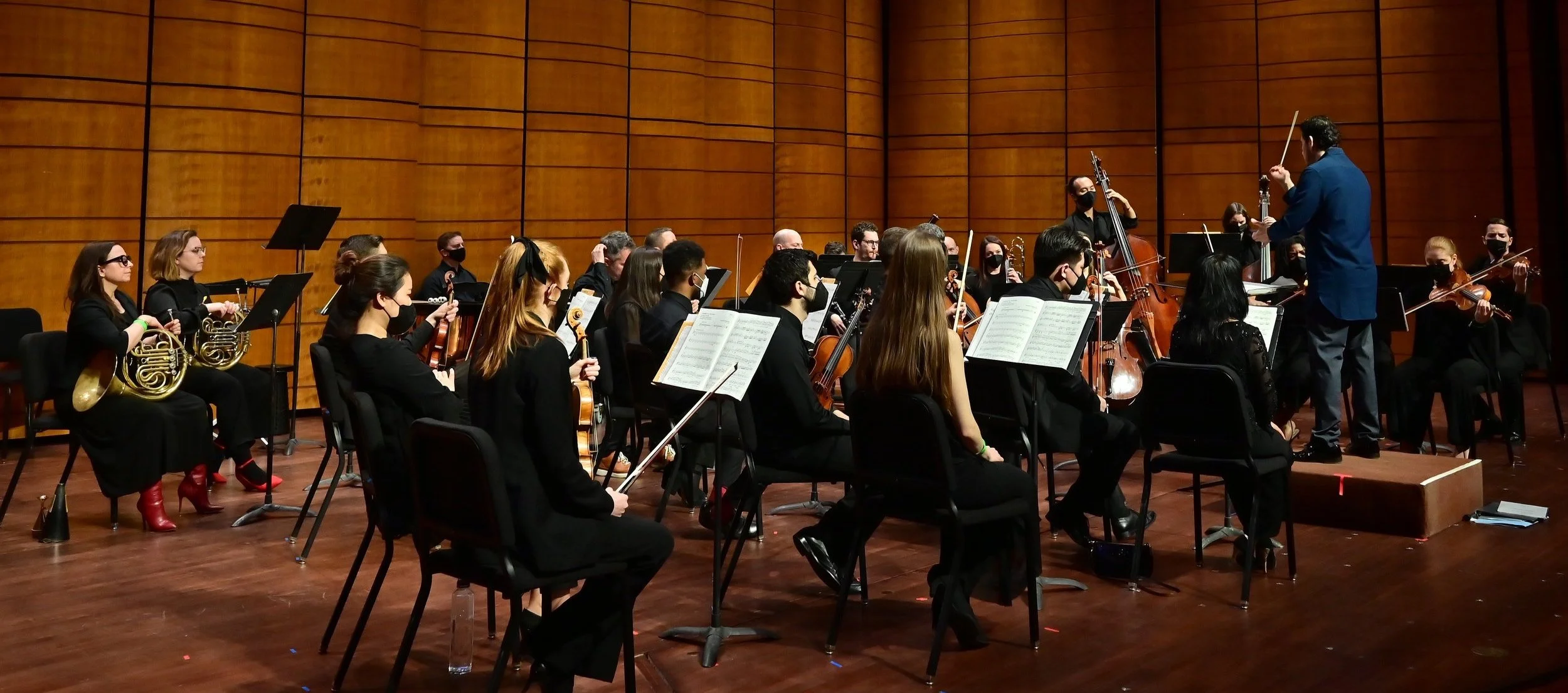
Violin I
Akemi Takayama, concertmaster
Wanchi Huang
Nancy Jin
Shu-Ting Yao
Shun Hioki
Aiveen GallagherViolin II
Sergey Prokofyev, principal
Sherri Zhang
Adelya Lindsay
Amyr Joyner
Dana GoodeViola
Dudley Raine IV, principal
Austin Simmons
Dan ZhangCello
Ben Capps, principal
Molly Aronson
Chiara PappalardoDouble Bass
Chris Chlumsky, principal
Nick Greer-YoungFlute
Conor Nelson, principal
Julee Kim Walker, piccolo
Jen ZhouOboe
Stephen Key, principal
Rick BasehoreClarinet
Jeremy Eig, principal
Daniel FrazelleBassoon
Erich Heckscher, principal
Ryan RomineContrabassoon
Nick CohenFrench Horn
Katy Ambrose, principal
Ian Zook
Karin Berkley
Mark HughesTrumpet
Chris Carrillo, principal
J.B. GreearTrombone
James Martin, principal
Myles Blakemore
Jerry ArmouryTimpani
Lee Hinkle, principal
New Orchestra of Washington
-
Officers
Dianne Peterson, Chair
Ann Yonemura, Secretary
Paul Connor, TreasurerBoard Members
Morris Deutsch
Rachel Dougan
Louise Harkavy
Neeta Helms
Joan Lewis
Tom Patton
Ryuji Ueno
Sinclair Vincent
Sarah Wilson
Grace Cho, ex-officio
Alejandro Hernandez-Valdez, ex-officio -
Alejandro Hernandez-Valdez, Artistic Director
Grace Cho, Executive Director
Will Esterling, Assistant Conductor
Abby Carlson, Manager of Operations
Richard Spero, Education and Community Coordinator
David Luo, Development Coordinator
Marc Lee, Digital Media and Marketing
Edgar Herrera, Development Consultant
Friends of NOW
The Friends of NOW is a vital group of supporters who empower and enable NOW to build a world where transformative musical experiences are accessible and available to All People.
-
Arts and Humanities Council of Montgomery County
Greater Washington Community Foundation
Dr. Sachiko Kuno
Maryland State Arts Council
National Endowment for the Arts
Dianne and Frank Peterson
Dr. Ryuji Ueno
Ann Yonemura -
Nancy and Morris Deutsch
Joan Lewis and Robbie Hopkins
Susan and David Rockefeller
Sarah Wilson and Lou Lappin -
Heather Hippsley and Paul Connor
Rachel Dougan
Lynn Knaupp and John Griffin in honor of Alejandro and Grace
Louise and Jon Harkavy
Kay and Don Jansky in honor of Alejandro and Grace
Ann and Knight Kiplinger
Laura DeBonis and Scott Nathan
Elizabeth and Thomas PattonNeeta Helms and Johan van Zyl
-
Atsuko and Robert Anders
Lauren Chelec and Elliot Cafritz
Patricia and Alton Frye
Ava and Neal Gross in honor of Nancy and Morris Deutsch
Grace Cho and Alejandro Hernandez-Valdez
Jon Hiatt and Barbara Shepp
Rusty Krauss
Rosalie Mandelbaum in loving memory of Perry Cohen
Jessica and Brian Markham
Ruth and Joseph McInerney
Barbara Rossotti
Nanette and David Schoeder
Patti Tice in honor of Alejandro -
Laurel and Hadi Bahar
Betsy and David Bennett
Patricia and John Bevacqua
Devar Burbage
Rose Lee and Steven Butler
Katie and Steve Capanna
Gail and John Edie
Herta and Jim Feely
Elizabeth Fox
Jan and Elizabeth Lodal
Robert Myers
Avril and David Rodney
Marta Goldsmith and Gary Rosenthal
Sherry Schiller
Rita Sloan -
Jane Aylward
Karen Baynard in honor of Louise Harkavy
Diana and Scott Carlson
Cynthia Dunbar and Charles Cerf
Constance Chan
Miles Chapin
Yuri Chayama
Peter Clunie
Heather Coryell
Jacqueline and Pete Davis
John Driscoll
Jonathan Eig
Barbara Finkelstein
Kathleen Plunkett and Bob Fruit
Marolyn and John Hatch
Gretchen Kuhrmann and Dan Stevens
Susan and Stephen Langley
Lucia Leith
Terri Lesko
Marilyn Lichtman
Linda and Robert Maddox in memory of Dorothy Clark
Janet and Ed Moyer
Alison and Warren Mullison
David Osborne
Laura Pruitt
Larry Robertson
Diedre Robinson
Elizabeth Savage
Deborah Boudreau and Michael Schwartz
Jane Williams and George Singleton
Howard Spendelow
Daphne Kiplinger and Dave Steadman
Andrea and Garrett Stevens
Warren and Elaine Stone
Carol and Doug Stuart
Nancy Witherell -
Kathleen and Leigh Alexander
Lois Buitano
Janine Byers
Blanca Cedillos in memory of Siegfried Wolf
Rachel Clark
Jonathan Eig
Maggie Emblom
Richard and Ethel Gilbert
Polly Gordon
Donald Grantt
Jill and Nathan Gross
Douglas Grove
Melissa Herman
Jean Jawdat
Mary Sue and Donald Johnson
Steve Kaffen
Nicole Lacroix
Pam and Don Lassell
Dee Daly and Phil Mazzara
Grant McClure
Frances James McKay
Anne and Tim Murphy
Carl Nash
Network for Good
Lisa Emenheiser Sarratt
Yulia Semchenko
Simon Sidamon-Eristoff
Penny Mills and Peter Simpson
Jeanie and Richard Teare
Alvin Thompson
Louise Waynant
Our Sponsors
NOW gratefully acknowledges the support of our 2022–2023 season sponsors:
Dianne and Frank Peterson
Ann Yonemura